
Conch: Competitive Debate Analysis via Visualizing Clash Points and Hierarchical Strategies
Qianhe Chen, Yong Wang, Yixin Yu, Xiyuan Zhu, and Ran Wang*.
IEEE Transactions on Visualization and Computer Graphics (Proceedings of IEEE VIS 25). 2025.
Paper Information
Authors: Qianhe Chen, Yong Wang, Yixin Yu, Xiyuan Zhu, Ran Wang
Venue: IEEE Transactions on Visualization and Computer Graphics (Proceedings of IEEE VIS 25). 2025.
Summary
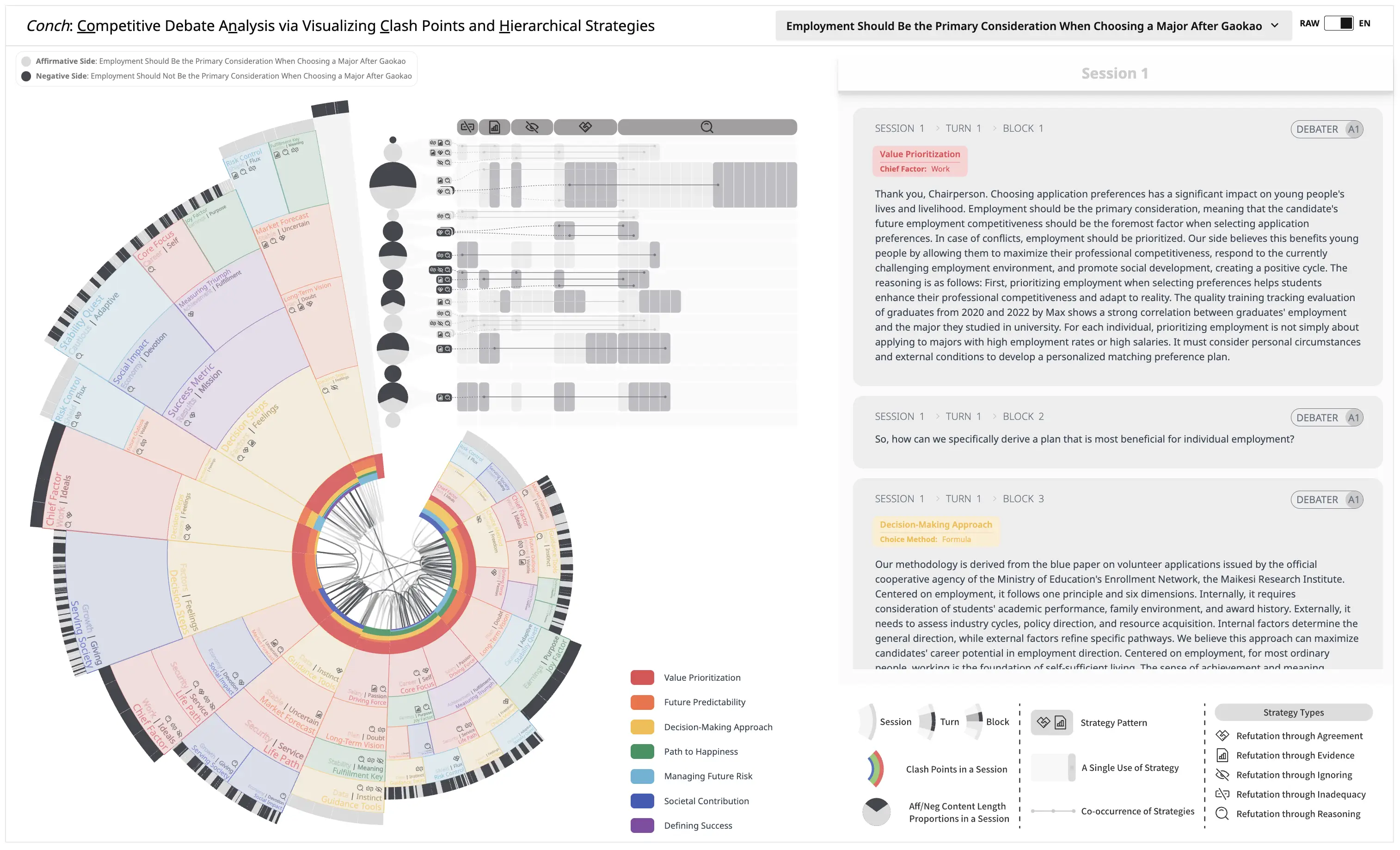
Conch is an interactive visualization system for post-hoc competitive debate analysis. It turns videos and transcripts into a hierarchy of blocks, clash points, disagreements, viewpoints, argumentative paths, and refutation strategies, then presents them through a multi-spiral process view, an augmented stacked-bar strategy view, and a detailed content view. The work is motivated by interviews with debaters, coaches, and experts, and is evaluated with two expert case studies plus a controlled user study against video and transcript review. The main evidence is that users completed equivalent tasks faster and reported a more learning-supportive cognitive-load profile, while expert validation reported high precision for the automatic structuring pipeline.
Why This Paper Matters
The paper addresses this question: How can an interactive visualization system help debaters and coaches reconstruct what was debated, how arguments interacted, and which refutation strategies were used across a competitive debate?
It is especially relevant to:
- Post-competition review by debate teams that need to reconstruct how clash points evolved and which arguments were defended, dropped, or modified across sessions.
- Coach-led strategy training, especially when comparing how opposing sides use refutation through evidence, reasoning, agreement, or other tactics over time.
- Instruction for novice debaters, where the hierarchy of clash points, disagreements, viewpoints, and strategies can serve as a scaffold for learning how competitive debates are organized.
Key Contributions
- Introduces Conch as an interactive system for hierarchical competitive debate analysis, helping debaters and coaches move beyond isolated claims toward clash points, disagreements, viewpoints, paths, and strategies.
- Defines a debate analysis hierarchy that links clash points to disagreements, viewpoints, and block-level paths, making long-range argumentative connections easier to inspect.
- Designs a compact parallel Archimedean spiral Process View that combines chronological session structure with clash-point interactions, reducing the clutter that would arise in a linear debate timeline.
- Designs an augmented stacked-bar Strategy View that compares refutation strategies within and across sessions while also exposing co-occurring tactics.
- Evaluates the system through two expert case studies and a controlled user study, providing evidence that Conch can speed up debate analysis and support more productive learning effort.
Method
- Elicit domain requirements from debate practitioners: The authors worked with debaters, coaches, and experts to identify the central analysis tasks: following debate evolution across sessions, identifying clash points and strategies, inspecting disagreement-level interactions, and reading original text details.
- Prepare debate data and segment it into analysis units: The workflow collects debates from multiple competitions, transcribes and corrects video audio, annotates debate roles and sessions, and segments the transcript into blocks that serve as the basic content units.
- Construct a hierarchical debate representation: The system combines a strategy framework with a content hierarchy of clash points, disagreements, viewpoints, and paths. Expert validation checks both strategy labels and the distribution of clash points or disagreements to blocks.
- Visualize temporal clash-point evolution: The Process View maps sessions to parallel Archimedean spiral segments, encodes clash-point distributions and blocks around the spirals, and uses an internal chord diagram to reveal interaction paths across sessions.
- Visualize strategies and original content: The Strategy View compares strategy usage and co-occurrence through augmented stacked bars, while the Content View lets users inspect the underlying block text and linked strategy annotations.
- Evaluate with expert case studies and a controlled user study: The evaluation uses two expert-led case studies and a user study comparing Conch against video and transcript review on debate-analysis tasks, time, cognitive load, and user ratings.
Evaluation and Findings
The evaluation uses ICDI debate used in the controlled user study with 27 debaters and coaches.
Conch averaged 51.1 minutes with all groups completing the tasks.
The evaluation is primarily qualitative, so the findings should be read with these caveats in mind:
- Video review averaged 76.1 minutes and transcript review averaged 94.4 minutes.
- The paper reports 32.8% less time than video review and 45.9% less time than transcript review, with both differences significant at p < 0.01.
- In the controlled user study, all groups completed the debate-analysis tasks, but participants using Conch finished faster: 51.1 minutes on average versus 76.1 minutes for video review and 94.4 minutes for transcript review.
- The cognitive-load results suggest that Conch did not make the task intrinsically easier, but it lowered extraneous load compared with transcript review and increased germane load compared with both video and text conditions.
- The expert case studies show the system’s intended analytic use: experts used the Process View and Strategy View to identify dominant clash points, uneven participation in disagreements, limited direct confrontation, and contrasting strategy patterns between debate sides.
- The automatic structuring pipeline achieved high expert-validated precision for block segmentation, strategy identification, and clash-point or disagreement distribution, supporting the reliability of the extracted hierarchy used by the visual interface.
- User feedback was positive overall, especially for effectiveness and usability, but the visual design and interaction were not uniformly easy to understand because the system combines several novel visual components.
Applications
This paper is most useful for:
- Debaters and coaches conducting post-competition review: The system is designed around reconstructing debate evolution, clash points, interactions, and strategy use from long records.
- Debate instructors and teams training novice debaters: The paper reports that beginners could use the system as a guide to core debate elements, while experts used it to make analysis more efficient.
- Visualization and discourse-analysis researchers: The paper contributes a combination of hierarchical argumentative abstraction, spiral temporal visualization, and strategy co-occurrence visualization for sequential debate text.
It is less suitable for:
- Speaker-level performance assessment: The system does not currently show the performance of each individual debater, such as contribution volume or argumentative efficiency.
- High-stakes fully automatic adjudication: The authors caution that current language models can still make structured-output mistakes in long-context or reasoning-heavy cases.
Limitations
- Conch does not currently provide speaker-level performance analysis; its focus is logical and structural debate content rather than individual debater metrics.
- The automatic structuring pipeline may still produce mistakes when context windows or reasoning demands exceed the capabilities of current language models.
- The interface has a learning curve because it combines several coordinated views and novel visual encodings; Q5 and Q9 received relatively lower ratings.
- The compact curved layout improves space use but can make some text difficult to read, so the system relies on hover popups for full content.
- The controlled user study used ICDI data as the experimental material, so broader generalization across every debate language, format, and tournament setting requires further evidence.
Frequently Asked Questions
What is the main idea of Conch?
Conch turns competitive debate records into a structured hierarchy of blocks, clash points, disagreements, viewpoints, paths, and refutation strategies, then visualizes their evolution and interaction across debate sessions.
What problem does the paper address?
It addresses the difficulty of manually reviewing long debate videos or transcripts, where important disagreements, strategic responses, and long-range argument connections are hard to reconstruct from raw text alone.
How does Conch differ from a transcript or ordinary timeline?
Rather than presenting debate content only in sequence, Conch links session structure with clash-point paths and strategy use. The spiral view emphasizes temporal evolution and interactions, while the strategy view compares tactic patterns between sides.
What evidence does the paper provide?
The paper reports two expert case studies and a controlled user study with debaters and coaches. Conch users completed analysis tasks faster than video or transcript users and showed higher germane load, suggesting more learning-oriented effort.
What limitations should readers keep in mind?
Conch focuses on logical and structural debate content rather than individual speaker performance. The pipeline may still make errors in difficult long-context cases, and the interface requires some learning because it introduces multiple coordinated visual designs.