
JobViz: Skill-driven visual exploration of job advertisements
Ran Wang, Qianhe Chen, Yong Wang*, Lewei Xiong, and Boyang Shen.
Visual Informatics. Volume 8, Issue 3, September 2024, Pages 18-28.
Paper Information
Authors: Ran Wang, Qianhe Chen, Yong Wang, Lewei Xiong, Boyang Shen
Venue: Visual Informatics. Volume 8, Issue 3, September 2024, Pages 18-28.
Summary
JobViz is a skill-driven visual analytics system for exploring online job advertisements. The paper addresses the gap between large recruitment portals and job seekers’ need to reason about skill requirements, similar positions, and practical job properties together. It processes 2.43 million computer-related 51Job advertisements, extracts skills into a structured framework, clusters posts by skill vectors, and presents them through coordinated overview, cluster, post map, and detail views. Evidence from two case studies and interviews with 26 users suggests that the approach helps users inspect skill patterns and filter posts more efficiently, while domain transfer, clustering scalability, and skill evaluation standards remain important cautions.
Why This Paper Matters
The paper addresses this question: How can a visual analytics system help job seekers explore large collections of online job advertisements through required skills, skill similarities, and job properties rather than relying only on basic listing filters?
It is especially relevant to:
- Computer-science job seekers who want to compare job advertisements by skill overlap, salary range, company category, and detailed requirements rather than starting only from job titles.
- University career services and advisors who need to explain market skill structures and help students identify plausible career options based on their abilities.
- Recruitment-interface designers studying how to add skill-centered browsing, similarity-based filtering, and linked visual exploration to job search tools.
Key Contributions
- The paper reframes job advertisement exploration around skills rather than only job titles or basic filters, which matters because applicants often need to understand which positions match their abilities and which nearby alternatives are available.
- It develops a processing pipeline that converts millions of job requirements into skill categories and normalized skill vectors, making large collections of advertisements comparable through skill structure.
- It introduces a coordinated visual analytics interface with overview, cluster exploration, post map, and detail views, supporting a progressive workflow from market-level patterns to individual job decisions.
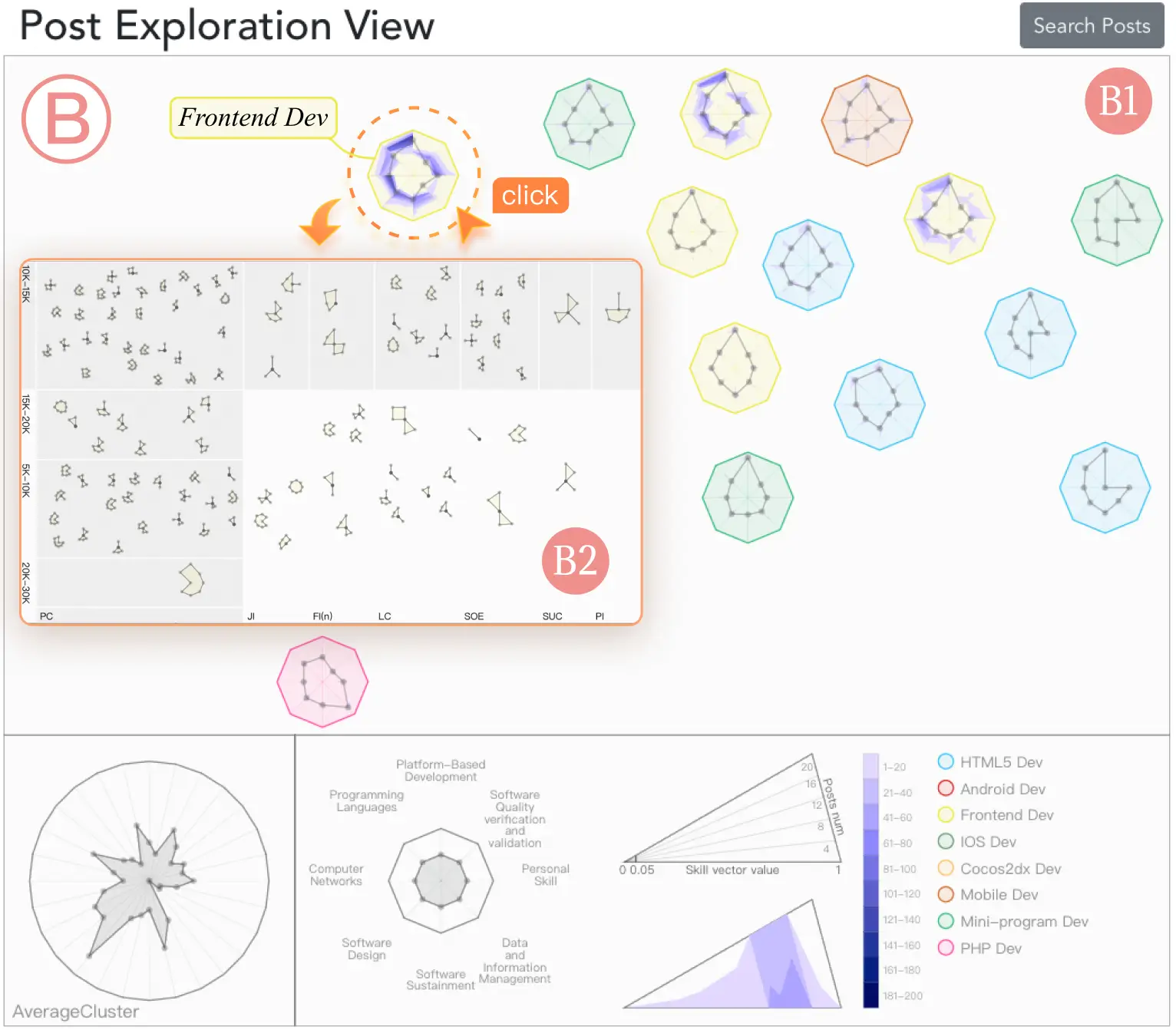
- It proposes an augmented radar-chart glyph that combines skill proportions with distribution cues, allowing users to compare job clusters and skill patterns in limited screen space.
- It evaluates the system through two realistic case studies and interviews with 26 target users, giving evidence that the workflow is understandable and useful for the studied computer-science job-seeking scenarios.
Method
- Derive job-hunting requirements: The authors interviewed job applicants and domain experts, then distilled four requirements: overview of skill-centered job properties, comparison of skill patterns, comparison of posts with similar skills, and post-level detail inspection.
- Collect job advertisements and define the skill framework: The study uses computer-related job advertisements collected from 51Job and organizes the analysis with a three-level computer science and engineering skill framework.
- Extract skill requirements from text: The processing pipeline filters requirement text, classifies requirement sentences, extracts key phrases with JioNLP, and uses manually checked phrase labels to build a skill dictionary.
- Represent and cluster advertisements by skills: Each advertisement is converted into a normalized skill vector. Pairwise similarity is computed from Euclidean distance, and affinity propagation groups selected posts into clusters without requiring a predefined cluster count.
- Provide linked visual exploration: The interface combines a skill-job overview, job cluster and post map views, an augmented radar-chart glyph, and a detail table so users can move from market patterns to individual advertisements.
- Evaluate with case studies and user interviews: The authors demonstrate workflows through two case studies and evaluate the system with 26 users completing five tasks, rating the system, and giving interview feedback.
Evaluation and Findings
The evaluation uses 26 target users from five universities and four companies, interviewed while using the online JobViz system.
Exploration effectiveness was rated mean 6.28 with standard deviation 0.56; usability was rated mean 6.30 with standard deviation 0.75; visual design and interactions were rated mean 6.29 with standard deviation 0.73. All task instances were completed within 17 minutes, and task averages were under 200 seconds.
The evaluation is primarily qualitative, so the findings should be read with these caveats in mind:
- The study did not include a controlled comparison condition; participant feedback includes qualitative comparison with recruitment websites.
- No numeric performance improvement against existing portals is reported; users described faster filtering and more skill-aware exploration than conventional recruitment sites.
- Generalizability is limited by the study setting: the evaluation uses computer-science-related posts from 51Job, and other industries or languages require additional framework construction and testing.
- Skill extraction is only partly automated. The classifier reports strong three-class accuracy, but key-phrase skill classification relies on trained assistants and expert review, and users raised concerns about proficiency standards.
- In the 26-participant user interviews, participants rated the system highly for exploration effectiveness, usability, and visual design/interactions, while task times averaged under 200 seconds. This supports the claim that the workflow is usable for the studied users, although it is not a controlled comparison with existing recruitment portals.
- The two case studies show how different applicants used the system: a graduating student explored frontend-related opportunities through skill similarity and salary, while a senior Android engineer balanced technical, leadership, salary, and welfare considerations.
- Participants particularly valued skill-centered exploration, including the ability to inspect post similarities and discover adjacent roles such as product manager alongside programming positions.
- The processing pipeline’s three-class sentence classifier reached 93.7% accuracy, giving practical support for large-scale skill extraction, while the later key-phrase-to-skill mapping still depended on manual and expert labeling.
- The evaluation also surfaced implementation and interpretation cautions: clustering efficiency may decline for very broad selections, and users wanted clearer standards for evaluating skill proficiency.
Applications
This paper is most useful for:
- Computer-science job seekers comparing opportunities by skill alignment: The system is explicitly designed to help users inspect required skills, similar job posts, and detailed advertisements in a computer-science recruitment setting.
- University career advisors and student-support teams: The requirements analysis and evaluation emphasize helping applicants understand the job market and skill requirements as a whole, especially when users are uncertain which positions they are qualified for.
- Visualization and recruitment-interface researchers: The paper contributes a coordinated visual analytics workflow and a compact augmented radar-chart glyph for comparing skill structures and post distributions.
It is less suitable for:
- Immediate deployment in unrelated industries without adaptation: The evaluation uses computer-science-related posts, and the authors state that other fields require their own skill frameworks before applying the approach.
- Analyses that require selecting an extreme number of position types at once: The authors note that the Post Exploration View may suffer from reduced clustering efficiency and cluster quality in this setting, even though typical users select only a smaller set of position types.
Limitations
- Visual scalability can degrade when users explore an extreme number of position types, because clustering efficiency and cluster quality may decline in the Post Exploration View.
- Generalizability is limited by the study setting: the evaluation uses computer-science-related posts from 51Job, and other industries or languages require additional framework construction and testing.
- Skill extraction is only partly automated. The classifier reports strong three-class accuracy, but key-phrase skill classification relies on trained assistants and expert review, and users raised concerns about proficiency standards.
- The user evidence is exploratory rather than comparative. Ratings, task completion, and interviews support usefulness, but the paper does not present a controlled experiment against existing recruitment websites.
- Salary representation is categorical because many job advertisements do not provide precise salary values, which limits fine-grained salary analysis.
Frequently Asked Questions
What is the main idea of JobViz?
JobViz makes skills the central navigation structure for job advertisements. Instead of asking users to inspect long lists of filtered posts one by one, it shows skill requirements, job types, salary and company attributes, clusters of similar posts, and detailed advertisements in linked views.
How does the system turn raw advertisements into comparable skill information?
The pipeline filters job requirements, classifies requirement sentences into technical skills, foundational skills, or irrelevant information, extracts key phrases, maps them into a skill dictionary, and represents each job advertisement as a normalized skill vector.
What evidence does the paper provide?
The paper reports two case studies using 51Job advertisements and in-depth interviews with 26 target users. Participants completed five open-ended tasks, gave high Likert ratings, and provided qualitative feedback about the usefulness of skill-centered exploration.
What are the main limitations?
The evaluation focuses on computer-science-related posts from 51Job, so other industries and languages require new skill frameworks and further testing. The Post Exploration View may also face scalability issues when users select an extreme number of position types.
How should this paper be used or cited?
It is most appropriate to cite the paper as a visual analytics and system-design contribution for skill-driven exploration of job advertisements, including its workflow, skill extraction process, and augmented radar-chart glyph. It should not be treated as a general labor-market benchmark across all domains.