
RecruitScope: A Visual Analytics System for Multidimensional Recruitment Data Analysis
Xiyuan Zhu, Wenhan Lyu, Chaochao Fu, Yilin Wang, Jie Zheng, Qiyue Tan, Qianhe Chen, Yixin Yu, and Ran Wang*.
International Conference on Human-Engaged Computing (ICHEC 2025).
Paper Information
Authors: Xiyuan Zhu, Wenhan Lyu, Chaochao Fu, Yilin Wang, Jie Zheng, Qiyue Tan, Qianhe Chen, Yixin Yu, Ran Wang
Venue: International Conference on Human-Engaged Computing (ICHEC 2025).
Summary
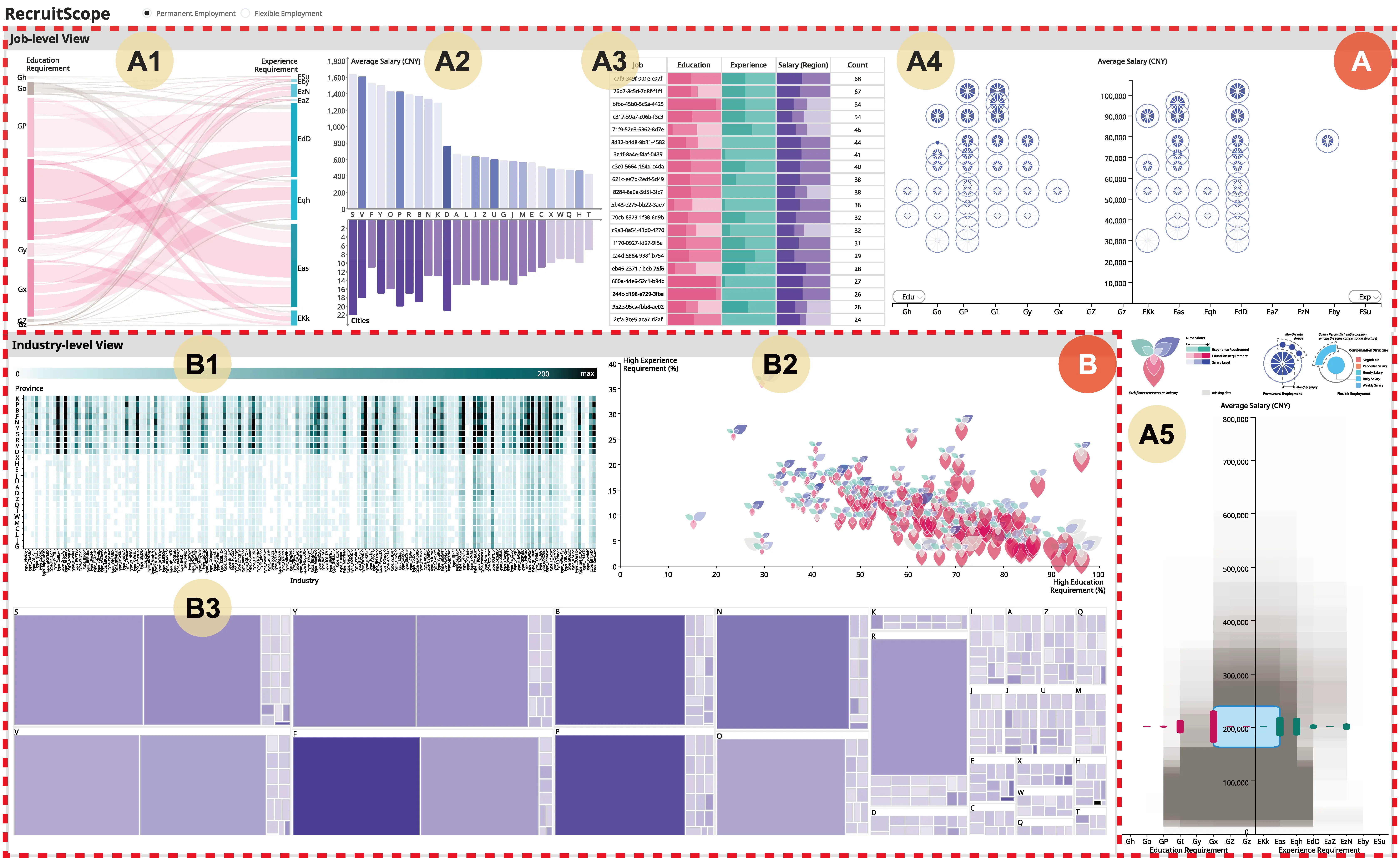
RecruitScope is a visual analytics system for exploring online recruitment data across job, region, salary, education, experience, and industry. It responds to the limitation that many job platforms expose only narrow filtering or pairwise comparisons. The system prepares anonymized ChinaVis Challenge data through position filtering, requirement recoding, salary normalization, and IQR outlier removal, then presents eight coordinated views across job-level and industry-level analysis. Its distinctive design is a flower-shaped scatterplot that embeds multidimensional requirements into compact industry glyphs. The paper demonstrates use through two archetypal case studies that identify regional salary opportunities, industry growth signals, and a high-salary emerging position with moderate entry barriers.
Why This Paper Matters
The paper addresses this question: How can a coordinated visual analytics system support multidimensional, cross-level exploration of recruitment data so job seekers and HR specialists can reason about salary patterns, industry dynamics, regional differences, and emerging positions?
It is especially relevant to:
- Exploring career options when salary, education, experience, region, and compensation type need to be considered together.
- Supporting HR specialists who want to compare market demand, adjust qualification thresholds, and identify possible talent shortages in emerging positions.
- Analyzing regional labor-market structure by combining job volume, salary intensity, industry preferences, and high-demand positions.
Key Contributions
- RecruitScope frames recruitment analysis as a cross-level visual analytics problem, linking individual jobs, regional distributions, industries, and salaries so users can move beyond pairwise platform filters.
- The system integrates eight coordinated views across job-level and industry-level analysis, making it easier to compare qualification thresholds, compensation structures, geographic patterns, and industry demand within one workflow.
- The paper introduces a flower-shaped scatterplot that combines spatial positioning with compact glyph encoding, which matters for comparing many industries while still showing internal differences in education, experience, and salary requirements.
- The data-processing workflow maps heterogeneous recruitment records into comparable forms through position filtering, requirement encoding, annual salary normalization, and IQR-based outlier handling.
- Two case studies illustrate how the system can support job-seeker decisions and employer recruitment strategy by revealing regional salary opportunities, industry growth signals, and high-salary positions with moderate entry barriers.
Method
- Define the analysis problem and user groups: The paper positions recruitment analysis as a multidimensional problem that simple filters cannot address, then focuses on job seekers and employers, particularly HR specialists, as the main users.
- Prepare anonymized recruitment data: The authors use anonymized ChinaVis Challenge recruitment records and filter a long-tailed position distribution to focus on the highest-volume positions.
- Encode requirements and normalize salaries: Education and experience requirements are grouped into broader levels, salary formats are converted to annual values, and IQR-based outlier removal is applied within grouped records.
- Construct job-level coordinated views: The Job-level View combines linked displays for qualification thresholds, regional distribution, job comparison, compensation structure, and requirement-salary distributions.
- Construct industry-level and regional views: The Industry-level View supports macro comparisons across industries and regions, including the flower-shaped glyph design and a regional profile view that combines salary, job, and industry information.
- Demonstrate use through archetypal cases: Two case studies walk through how the system reveals salary opportunities, regional effects, and emerging-position signals for a job seeker and an employer.
Evaluation and Findings
The evaluation uses 2024 ChinaVis Challenge anonymized recruitment data.
The two cases reveal regional salary distribution patterns, industry evolution trends, and high-demand emerging roles in the job market.
The evaluation is primarily qualitative, so the findings should be read with these caveats in mind:
- The paper does not report a controlled baseline, so the comparison should be read as qualitative and exploratory.
- No numerical improvement is reported; the contribution is demonstrated through broader exploratory coverage and decision-support scenarios.
- The evaluation is illustrative rather than controlled, because the paper reports two archetypal case studies and no quantitative usability comparison.
- The main evaluation is qualitative: two case studies show that RecruitScope can reveal regional salary distribution patterns, characterize industry growth trajectories, and discover emerging roles, but the paper does not report measured task performance.
- In the job-seeker case, the GP-EdD qualification pairing appears to have substantial demand, and the selected position shows annual salaries of 50,000 to 160,000 CNY in particular industries and regions.
- The regional analysis changes the job seeker's decision process by highlighting Prov-K and Prov-F as higher-salary targets, rather than relying only on top-tier city assumptions.
- In the employer case, Pos-eb45-2371-1beb-76f6 is interpreted as a talent-gap signal: it has medium education and low experience requirements but annual salaries of 80,000 to 150,000 CNY, higher than comparable positions.
- The flower-shaped scatterplot is presented as a way to reduce clutter in large-scale industry comparison while preserving both relative market position and internal requirement composition.
Applications
This paper is most useful for:
- Job seekers comparing career options across qualification, region, salary, and compensation structure: The system explicitly supports analysis of job positions and salary patterns and the first case study shows how regional and industry views can reshape a job seeker's choices.
- Employers and HR specialists planning recruitment strategy: The paper targets HR specialists and demonstrates how a company can interpret high-salary, moderate-threshold positions as talent-gap signals and adjust recruitment plans.
- Labor-market analysts studying regional and industry patterns in online vacancies: RecruitScope connects industry-level, regional, occupational, and salary information, making it useful for exploratory analysis of market structure.
It is less suitable for:
- Teams that need validated transfer across many recruitment platforms or data schemas: The authors state that generalization across datasets with different structures still needs validation.
- Users who need compact automatic summaries instead of cross-view exploration: The paper notes that RecruitScope lacks compact summarization and that nonlinear relationships may require reasoning across multiple views.
Limitations
- Generalization to recruitment datasets with different structures or sources remains unvalidated.
- The system lacks compact summarization; some nonlinear relationships among education, experience, and salary require cross-view reasoning.
- The evaluation is illustrative rather than controlled, because the paper reports two archetypal case studies and no quantitative usability comparison.
- Filtering to the top 1% of positions stabilizes analysis around high-volume roles but may leave some long-tail or rare-position signals outside the demonstrated workflow.
- The authors identify learning curve and usability as areas for further improvement.
Frequently Asked Questions
What is RecruitScope's main idea?
RecruitScope is a coordinated visual analytics system for recruitment data. It helps users move between job-level details and industry-level patterns while comparing qualifications, salary, geography, and compensation structure.
What makes the visualization design distinctive?
The paper's most distinctive design is the flower-shaped scatterplot. Each industry is represented as a compact glyph whose petals encode education, experience, salary, and missing values, while its position shows the industry's relationship to high-education and high-experience demand.
What evidence does the paper provide?
The paper demonstrates the system with two archetypal case studies using anonymized ChinaVis Challenge recruitment data. The cases show how a job seeker and an employer can discover salary, regional, industry, and emerging-position patterns.
What are the main limitations?
The authors note that generalization to recruitment datasets with different structures still needs validation. They also state that RecruitScope lacks compact summarization, so some nonlinear salary and qualification relationships require cross-view reasoning.
How should this paper be used or cited?
It is most appropriate to cite the work as a visual analytics system for multidimensional recruitment data and as a design example for glyph-based, cross-level labor-market exploration.